La Palma – la isla bonita
You know, of course, the pleasures of air travel, The relaxed drive to the airport; the cheerful check in staff; the friendly security people; the two minute walk to the aircraft where you are welcomed aboard and seated in a comfortable and spacious seat. No? Well perhaps we can dream!
Our outward journey began with the rather too insistent alarm at 2.30 am and finished a little over twelve hours later on the small and charming, westerly edge of the Canary islands.
We geologists know that there is lots of evidence of a volcanic past all over the UK, but due to millions of years of erosion, trying to find actual volcanoes is nye on impossible, so we came to this island, which is composed of nothing else. It is quite small, but is also rugged and extremely steep. The central north is dominated by the magnificent crater at the heart of the Taburiente volcano, whilst to the south is the active volcanic ridge known as Cumbre Vieja. The north and east of the island are quite thickly forested, whilst the south and west are bare black rock and often quite bleak. So quite a contrast. This going to be a difficult article to write, as I suspect that I shall soon run out of superlatives, but here goes.
Our base was a hotel just to the south of the island’s capital Santa Cruz. A remarkable collection of multi coloured buildings, some dating back to the 16th Century. Since this is a small island, we managed to cover much of it in our week’s stay. For the first three days we centred our exploration around the spectacular Taburiente crater. After looking at a huge scarred landscape where 3 000 000 000 000 tons of rock collapsed into the Atlantic creating giant tsunami waves, we walked along a deeply incised valley into the ancient volcanic core of the island, small cries of delight accompanying each discovery. This was the text book brought vividly to life
Day two saw us visiting the National Park at Cumbreceita where the brilliant sunshine revealed a beautiful panorama of fragrant pine trees and a different sequence of younger volcanic rocks, although younger here probably means about 750 000 years old. Even we geologists were impressed by the gentle ambience of this beautiful place. The two hours allocated to us by the Park Authority passed far too quickly.
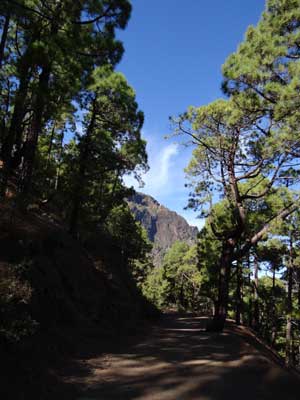
Cumbreceita National Park
At just over 2400 metres high, La Palma is not only steep but quite difficult to get around. With over 200 bends to negotiate, it is quite a slow journey to the very top. The Canarian houses gradually become more spaced out as the forest thickens and then we ascend into cloud and rain. After just a few minutes, the greyness thins and we burst through into the clear spectral blue sky with views of over a hundred kilometres. The dazzling white cloud tops contrasting sharply with black, orange and red rocks. But that is only the backdrop to the Isaac Newton group of telescopes that we were to visit. The largest optical telescope in the world, coupled with one called MAGIC kept us fascinated by their complexity and their scientific capability. Eating lunch on such a fabulous viewpoint was no disappointment either.
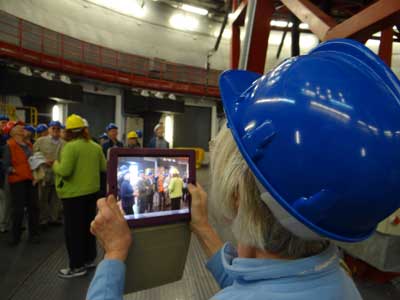
Inside the world’s largest telescope
At about 4 million years the oldest La Palman rocks are comparatively young, but two of the sites we visited featured rocks that were younger than our party, having been erupted in 1949 and 1971. The former lavas were very fluid and as they ran down the mountain into the sea they formed tubes which we explored with local guides. This rugged troglodyte world was not to everyone’s taste, but did show some of this island’s remarkable variety.
Teneguia volcano erupted with relatively little warning and for less than a month, but produced a remarkably large amount of lava. Two people were killed by the eruption – both being asphyxiated by the gases driving the spectacular lava fountains. So it was only to be expected that our leader would set us the task of finding the fumeroles from which these same toxic gases still arise!
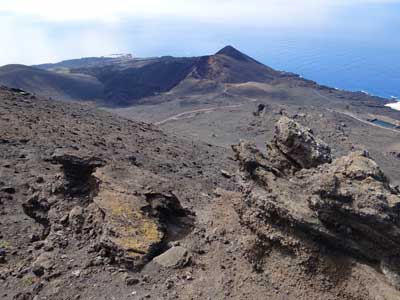
Volcan Teneguia – just a youngster at 43
On our final visit it seemed fairly natural to spend a little time looking at the archaeology of the island to understand how the pre-spanish Guancha people used the island’s natural resources to their advantage. The caves at Balmaco showed how skilfully they managed, and also that they had an artistic temperament as well.
Our first overseas field trip has certainly wetted our appetite for more.